
Interactive Melodies 007
Games played since January.

Eternal Darkness (Silicon Knights, 2002, GameCube)
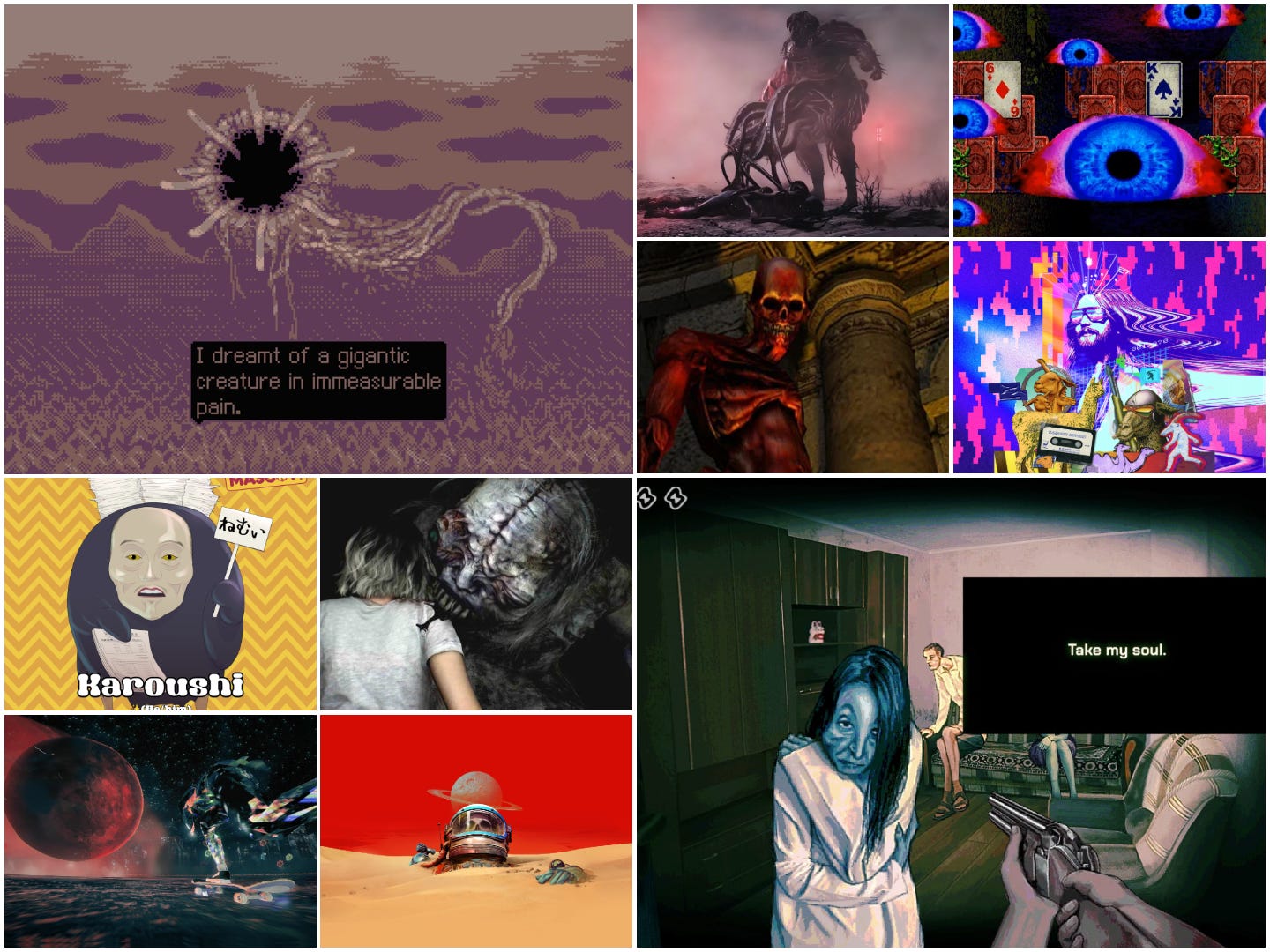
Few games since this proudly Canadian title have grappled with the spatiotemporal scope of Lovecraftian Weird. Eternal Darkness, backed by Nintendo (who then patented the sanity effect mechanic), builds a deep archaeology of cosmic horror with only a handful of missteps. The occasional clumsy chapter and awkward combat are offset by an unusual rune-based spellcasting system, unfortunately underused as a one-way puzzle solution, and the aforementioned sanity mechanics. Some of the visual effects remain very effective, notably the subterranean Lemurian cities engraved with agonizing faces, which are still impressive today. In an onslaught of questionable remasters, this one actually deserves to be modernized.
Cronos: The New Dawn (Bloober Team, 2025, PS5)
After their bloated adaptation of Silent Hill 2, I reluctantly approached Bloober’s Cronos based on friends’ recommendations. Their attempts at anything more than walking simulator mechanics, The Medium, for instance, were always short of disappointing. I’m glad to say I thoroughly enjoyed this new IP, with Bloober finally finding its identity in a game that fully incorporates excellent combat mechanics. It feels like playable version of Piotr Szulkin’s films with a serving of biomorphic abominations. The FromSoftware-inspired level design works well with the transhumanist interface (deleting entire personalities never gets old). Brutal, visceral, challenging, and a great story to boot.
Llamasoft: The Jeff Minter Story (Digital Eclipse, 2024, Steam Deck)
Less a collection than an interactive documentary, Llamasoft offers a rare glimpse into the specific context of British video game culture and industry. I felt it acted as a joyful counterpart to Jarett Kobek’s essay on Soft & Cuddly (published by Boss Fight Books), focusing less on Sinclair Research hardware and more on the surrounding community, as well as how the professionalization of development forced the early mavericks to adapt. A fascinating time capsule, even if it includes too few of Minter’s recent titles.
The Invincible (Starward Industries, 2023, Steam Deck)
A walking simulator transposition of Stanisław Lem’s novel with some interesting branching narratives. The extremely slow buildup could have been paced better, especially when the main activity consists of trudging through endless beige landscapes. It would have been harder to recommend without the final section, which raises relevant posthumanist questions, namely, how the perceived horror of the human condition when facing the unknown may function as a threshold to be crossed.
Artis Impact (Mas, 2025, Steam Deck)
I’m always somewhat amazed by creators who invest themselves in Sisyphean worldbuilding projects and manage to follow through. With Artis Impact, Mas created something that transcends expectations for a JRPG, though more as a multimedia experience. Everything is minutely crafted and offers an idiosyncratic tone that never quite percolates into the narrative, exploration, or mechanics. It is aesthetically one of the most pleasing games I’ve played in recent years, but also strangely shallow despite its amount of content. In fact, the whole artefact might have benefited from shedding the JRPG framework altogether.
Resident Evil: Requiem (Capcom, 2026, PS5)
The first two acts are incredible. Hideshi Hino-like grotesqueries, syringes filled with Hokuto no Ken-style flesh-exploding fluid, the best handgun since Jan Kounen’s Dobermann, strong level design, and the return of Leon Kennedy as a full-blown infected-splattering machine. Then the final act falls completely flat: the most disappointed I have ever been with this IP. A good alternative would have been to narratively insert a Mercenaries mode right then and there, or just go full blast with the assumed narrative dissonance that permeates the whole game.
Promise Mascot Agency (Kaizen Game Works, 2025, Steam Deck)
I cannot think of a more tedious mechanic than fetch quests and treasure hunting, yet every time I play one, I become addicted. This already happened with Kaizen Game Works’ previous title Paradise Killer, where I ended up collecting everything on the map. Promise Mascot Agency improves on that formula by replacing the PK's character designs, often celebrated but somewhat uninspiring to me, with bizarre mascots and hilariously cliché yakuzas. Some characters, notably Karoushi, are absolutely brilliant. Developing relationships can feel like a chore, but it usually leads to rewarding moments. All in all, it taps into a strange hunter-gatherer atavism.
Fallow (Ada Rook, 2021, Steam Deck)
Anyone familiar with Ada Rook’s interactive work knows what to expect: doomsday melancholia and the exploration of liminal states. Her games act as a compelling counterpart to the aggression of her music, but Fallow stands as her strongest masterpiece. Every aspect, from sound to text, seems carefully crafted, especially in the secret parallel world. It’s a prime example of how remixing and reusing assets can push unexpected rhizomatic possibilities (something all developers should try out, plunderwaring through their own stuff), forming a kind of mutant twin to the main plot.
Skate Story (Sam Eng, 2025, Steam Deck)
You play a moon-consuming demon made of glass skating through all layers of hell. The void is rendered as Unity’s default screen. The music is awesome. The whole game is as humorous as it is visually striking. I even learned a few things about skating. Highly recommended short mindfuck.
Forbidden Solitaire (Grey Alien Games, Night Signal Entertainment, 2026, Steam Deck)
I was rereading Jesper Juul’s A Casual Revolution section about the importance of Solitaire when this was finally released, so I had to try it. It captures the CD-ROM shovelware era of the nineties while integrating a competent ARG layer, some challenging levels, and strong design ideas. Deformed troglodytes and lo-poly enucleation are your rewards, instead of Windows’ Solitaire cascade effect.
No, I’m Not a Human (Trioskaz, 2025, Steam Deck)
Just when it feels like analog horror has exhausted itself for good, Trioskaz tweaks the recipe just enough to keep it engaging. It replaces Alternates with Visitors in a suffocating world shaped by isolation, misanthropy, solar heat death, and paranoia. It is a grim experience, filled with dark humor and hopelessness, suggesting that dying and surviving are equally bleak outcomes. Everything feels rotten, partly due to the greenish hue. You could smell the physical examination gameplay loop, especially when it comes to the armpits. If, like me, that’s your cup of tea, the game also offers plenty of replay value with various endings and a large cast of weirdos to shelter (or forcefully send to be tested at black-site facilities).